

Media
|
News
September 16, 2026
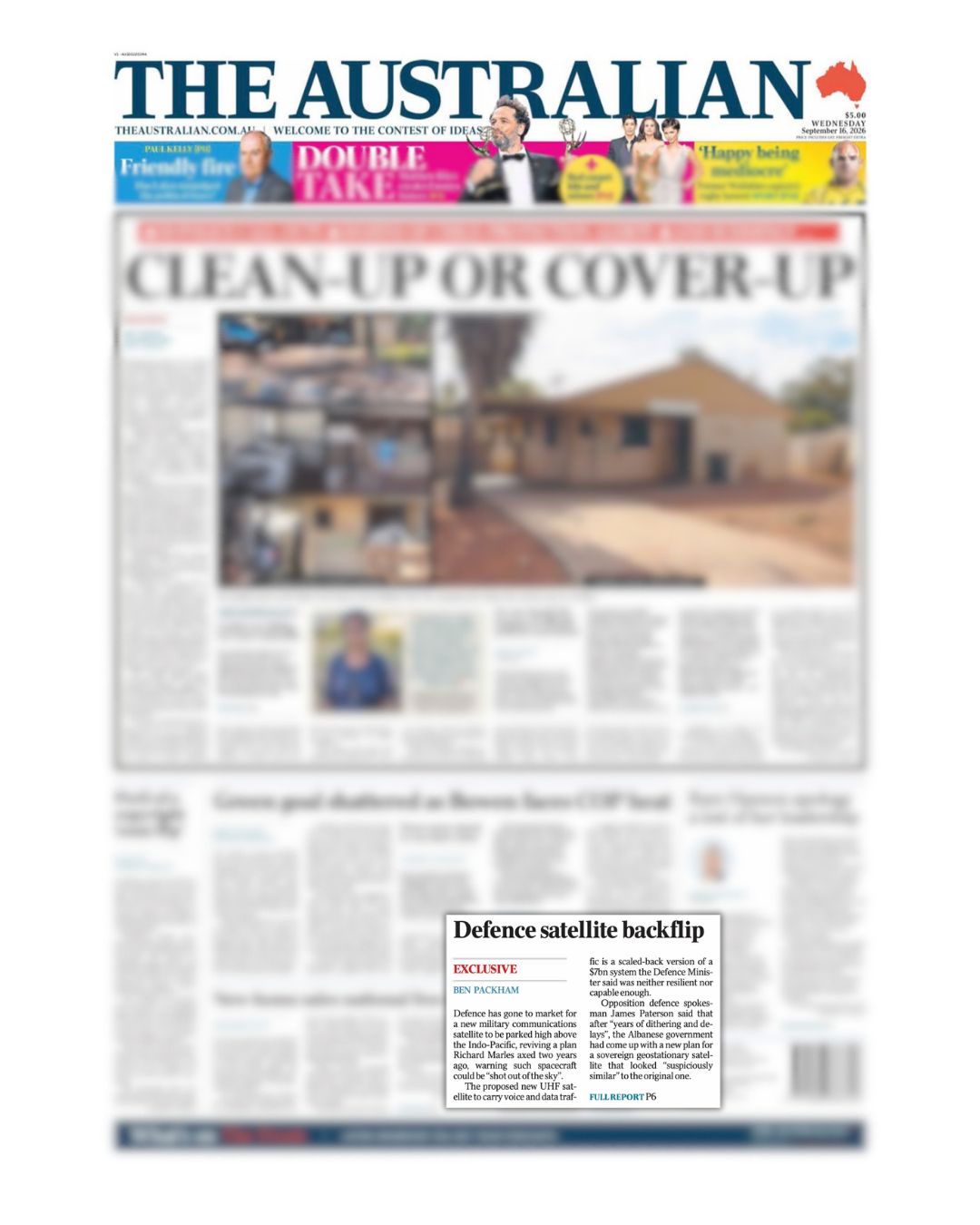
Defence has gone to market for a new military communications satellite to be parked high above the Indo-Pacific, reviving a plan Richard Marles axed two years ago and warned such spacecraft could be “shot out of the sky”.
The proposed new UHF satellite to carry voice and data traffic is a scaled-back version of a $7bn system the Defence Minister said was neither resilient nor capable enough.
A request for tender published last week seeks a single geostationary satellite that would hover in a fixed position 36,000km above the equator, rather than a network of three to five such satellites as originally planned. Future tenders will seek wideband satellites for high-volume data and new ground control systems.
Defence spent $102m on the earlier plan, known as JP9102, which first went to tender in 2021. The preferred vendor, US defence giant Lockheed Martin, reportedly lost about $300m worth of investment.
The winning bidder for the first stage of the proposed new system won’t be selected until the middle of next year at the earliest, and. despite government warnings of “unprecedented strategic circumstances”, will then have five years to deliver a capability.
Opposition defence spokesman James Paterson said that after “years of dithering and delays”, the government had come up with a new plan for a sovereign geostationary satellite that looked “suspiciously similar” to the original one.
“In the dangerous strategic circumstances Australia faces, it is frankly embarrassing it has taken the Albanese government five years to come back to where we started, and have no capability to show for it,” Senator Paterson said.
“Their stated reason for cutting this capability in 2024 is now clearly in question. The most precious resource right now for Australia’s defence is time. Labor acts as though Australia has more strategic warning time than ever.”
A defence industry source told The Australian: “What they have effectively done is delayed, cancelled, and gone back to ask companies for a component of what they originally asked for.
“These decisions have an impact on the role Australia’s defence industry can play, when changes and cancellations make it harder to include Australian companies on the journey.”
The ADF’s current UHF communications rely on an Optus satellite launched in 2003 and a leased payload on Intelsat 22, which is also an ageing system.
Dr Malcolm Davis, a senior analyst with the Australian Strategic Policy Institute, said there was no word from the government on when the full satellite communications system would be delivered.
He warned “there will be serious risks of a capability gap opening up” if Defence was still dragging its heels when its next investment plan was announced in 2028.
“They will most likely still get access to the US Wideband Global SATCOM system, and they can use Starlink for non-critical purposes, but we’ll lack a sovereign-controlled ADF satcom capability in spite of this project being under way for over a decade,” Dr Davis said.
Mr Marles pushed back when The Australian revealed in November 2024 that JP9102 had been cancelled, saying it had been rescoped “to take into account … developments in technology, so that we have a more distributed solution to future Defence communications”.
“In the process, we address the threats to technology where we do see capabilities which enable satellites to literally be shot out of the sky,” he said.
“In progressing this, we believe we can do this in a more resilient way, and therefore a more capable way, in a more timely way, and a more cost-effective way.”
A Defence spokeswoman told The Australian on Tuesday the department was pursuing “a resilient, multi-orbit satellite communications capability, optimised for operations and enhanced communications in the Indo-Pacific in a way that reflects advances in technology and grows opportunities for the sovereign Australian defence industry over time”.
“Defence is delivering this capability through multiple elements under Project SPACE 9102,” she said.
“In the contemporary space operating environment, all orbital regimes remain at risk and the proposed narrowband geostationary satellite represents one part of a broader resilient architecture that Defence is pursuing through SPACE 9102.”
The spokeswoman said the government would invest up to $12bn over the coming decade in “enhanced space capabilities” for Defence.
Science and Industry Minister Tim Ayres said in July the government wanted Australian industry to play a bigger role in the global space economy, which is forecast to be worth $US1.8 trillion by 2035.
Space Industry Association of Australia chief executive Dan Lloyd said the sector was “very pleased that there’s new activity focused on space”.
“Would industry have preferred a consistent momentum and trajectory? Absolutely,” he said. “That’s much easier for building industry, but given the length of time that JP9102 had been running, it was fair to say that it was an opportune moment to review the architecture, the capability, and to refresh.”