

Media
|
News
September 14, 2026
Monday 14 September 2026
The Australian
Stephen Rice
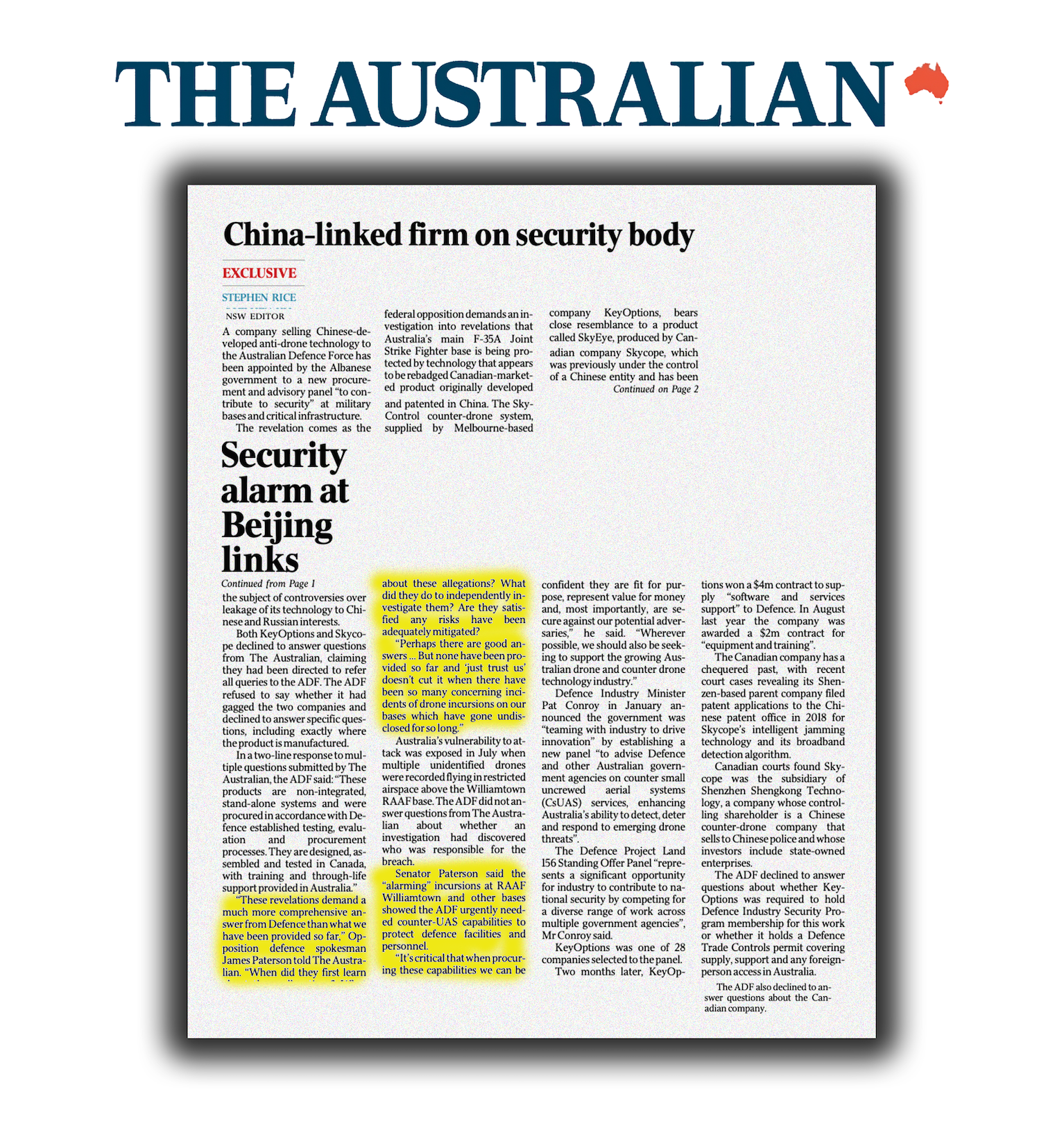
A company selling Chinese-developed anti-drone technology to the Australian Defence Force has been appointed by the Albanese government to a new procurement and advisory panel “to contribute to security” at military bases and critical infrastructure.
The revelation comes as the federal opposition demands an investigation into revelations that Australia’s main F-35A Joint Strike Fighter base is being protected by technology that appears to be a redbadged Canadian-marketed product originally developed and patented in China.
The SkyControl counter-drone system, supplied by Melbourne-based company KeyOptions, bears close resemblance to a product called SkyEye, produced by Canadian company Skycope, which was previously under the control of a Chinese entity and has been the subject of controversies over leakage of its technology to Chinese and Russian interests.
Both KeyOptions and Skycope declined to answer questions from The Australian, claiming they had been directed to refer all queries to the ADF. The ADF refused to say whether it had gagged the two companies and declined to answer specific questions, including exactly where the product is manufactured.
In a two-line response to multiple questions submitted by The Australian, the ADF said: “These products are non-integrated, stand-alone systems and were procured in accordance with Defence established testing, evaluation and procurement processes. They are designed, assembled and tested in Canada, with training and through-life support provided in Australia.”
“These revelations demand a much more comprehensive answer from Defence than what we have been provided so far,” Opposition defence spokesman James Paterson told The Australian. “When did they first learn about these allegations? What did they do to independently investigate them? Are they satisfied any risks have been adequately mitigated?
“Perhaps there are good answers for these questions. But none have been provided so far and ‘just trust us’ doesn’t cut it when there have been so many concerning incidents of drone incursions on our bases which have gone undisclosed for so long.”
Australia’s vulnerability to attack was exposed in July when multiple unidentified drones were recorded flying in restricted airspace above the Williamtown RAAF base. The ADF did not answer questions from The Australian about whether an investigation had discovered who was responsible for the breach.
Senator Paterson said the “alarming” incursions at RAAF Williamtown and other bases showed the ADF urgently needed counter-UAS capabilities to protect defence facilities and personnel.
“It’s critical that when procuring these capabilities we can be confident they are fit for purpose, represent value for money and, most importantly, are secure against our potential adversaries,” he said. “Wherever possible, we should also be seeking to support the growing Australian drone and counter drone technology industry.”
Defence Industry Minister Pat Conroy in January announced the government was “teaming with industry to drive innovation” by establishing a new panel “to advise Defence and other Australian government agencies on counter small uncrewed aerial systems (CsUAS) services, enhancing Australia’s ability to detect, deter and respond to emerging drone threats”.
The Defence Project Land 156 Standing Offer Panel “represents a significant opportunity for industry to contribute to national security by competing for a diverse range of work across multiple government agencies”, Mr Conroy said.
KeyOptions was one of 28 companies selected to the panel.
Two months later, KeyOptions won a $4m contract to supply “software and services support” to Defence. In August last year the company was awarded a $2m contract for “equipment and training”.
The specifications and marketing material of the Australian SkyControl product is almost identical to that of the Canadian SkyEye.
The Canadian company has a chequered past, with recent court cases revealing its Shenzen-based parent company filed patent applications to the Chinese patent office in 2018 for Skycope’s intelligent jamming technology and its broadband detection algorithm.
Canadian courts found Skycope was the subsidiary of Shenzhen Shengkong Technology, a company whose controlling shareholder is a Chinese counter-drone company that sells to Chinese police and whose investors include state-owned enterprises.
The ADF declined to answer questions about whether KeyOptions was required to hold Defence Industry Security Program membership for this work or whether it holds a Defence Trade Controls permit covering supply, support and any foreign-person access in Australia.
The ADF also declined to answer questions about the Canadian company, including whether Defence Export Controls classified SkyControl/SkyEye against the Defence and Strategic Goods List and what KeyOptions’ Foreign Ownership, Control or Influence declaration said about Skycope, or Skycope’s previous parent company, Shenzhen Shengkong Technology.
A Skycope SkyEye device, identical to marketing images used by KeyOptions, was found by The Australian advertised on a commercial Russian website for 7.8m rubles (around $129,000), with the seller listing China as the country of origin.