

Media
|
News
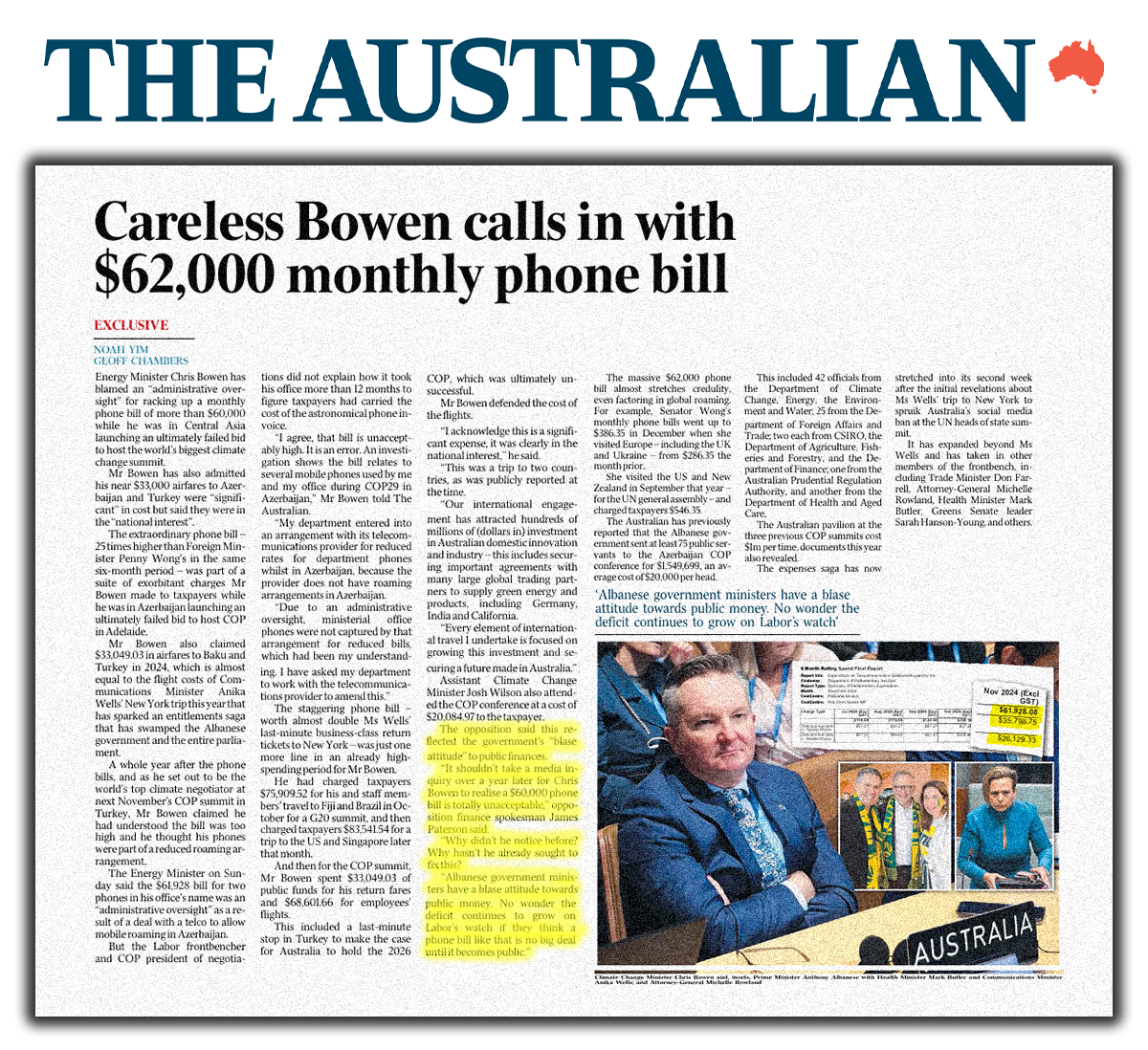
Energy Minister Chris Bowen has blamed an "administrative oversight" for racking up a monthly phone bill of more than $60,000 while he was in Central Asia launching an ultimately failed bid to host the world's biggest climate change summit.
Mr Bowen has also admitted his near $33,000 airfares to Azerbaijan and Turkey were "significant" in cost but said they were in the "national interest".
The extraordinary phone bill 25 5times higher than Foreign Minister Penny Wong's in the same six-month period was part of a suite of exorbitant charges Mr Bowen made to taxpayers while he was in Azerbaijan launching an ultimately failed bid to host COP in Adelaide.
Mr Bowen also claimed $33,049.03 in airfares to Baku and Turkey in 2024, which is almost equal to the flight costs of Communications Minister Anika Wells' New York trip this year that has sparked an entitlements saga that has swamped the Albanese government and the entire parliament.
A whole year after the phone bills, and as he set out to be the world's top climate negotiator at next November's COP summit in Turkey, Mr Bowen claimed he had understood the bill was too high and he thought his phones were part of a reduced roaming arrangement.
The Energy Minister on Sunday said the $61,928 bill for two phones in his office's name was an "administrative oversight" as a result of a deal with a telco to allow mobile roaming in Azerbaijan.
But the Labor frontbencher and COP president of negotiations did not explain how it took his office more than 12 months to figure taxpayers had carried the cost of the astronomical phone invoice.
"I agree, that bill is unacceptably high. It is a an error. An investigation shows the bill relates to several mobile phones used by me and my office during COP29 in Azerbaijan," Mr Bowen told The Australian.
"My department entered into an arrangement with its telecommunications provider for reduced rates for department phones whilst in Azerbaijan, because the provider does not have roaming arrangements in Azerbaijan.
"Due to an administrative oversight, ministerial office phones were not captured by that arrangement for reduced bills, which had been my understanding. I have asked my department to work with the telecommunications provider to amend this."
The staggering phone bill worth almost double Ms Wells' last-minute business-class return tickets to New York was just one more line in an already high spending period for Mr Bowen.
He had charged taxpayers $75,909.52 for his and staff members' travel to Fiji and Brazil in October for a G20 summit, and then charged taxpayers $83,541.54 for a trip to the US and Singapore later that month.
And then for the COP summit, Mr Bowen spent $33,049.03 of public funds for his return fares and $68,601.66 for employees' flights.
This included a last-minute stop in Turkey to make the case for Australia to hold the 2026 COP, which was ultimately unsuccessful.
Mr Bowen defended the cost of the flights.
"I acknowledge this is a significant expense, it was clearly in the national interest," " he said.
"This was a trip to two countries, as was publicly reported at the time.
"Our international engagement has attracted hundreds of millions of (dollars in) investment in Australian domestic innovation and industry this includes securing important agreements with many large global trading partners to supply green energy and products, including Germany, India and California "Every element of international travel l undertake is focused on growing this investment and securing a future made in Australia."
Assistant Climate Change Minister Josh Wilson also attended the COP conference at a cost of $20,084.97 to the taxpayer.
The opposition said this reflected the government's "blase attitude" to public finances.
"It shouldn't take a media inquiry over a year later for Chris Bowen to realise a $60,000 phone bill is totally unacceptable," opposition finance spokesman James Paterson said.
"Why didn't he notice before? Why hasn't he already sought to fix this?
"Albanese government ministers have a blase attitude towards public money. No wonder the deficit continues to grow on Labor's watch if they think a phone bill like that is no big deal until it becomes public."
The massive $62,000 phone bill almost stretches credulity, even factoring in global roaming. For example, Senator Wong's monthly phone bills went up to $386.35 in December when she visited Europe including the UK and Ukraine from $286.35 the month prior.
She visited the US and New Zealand in September that year forth the UN general assembly and charged taxpayers $546.35.
The Australian has previously reported that the Albanese government sent at least 75 public servants to the Azerbaijan COP conference for $1,549,699, an average cost of$20,000 per head.
This included 42 officials from the Department of Climate Change, Energy, the Environment and Water; 25 from the Department of Foreign Affairs and Trade; two each from CSIRO, the Department of Agriculture, Fisheries and Forestry, and the Department of Finance; one from the Australian Prudential Regulation Authority, and another from the Department of Health and Aged Care.
The Australian pavilion at the te three previous COP summits cost $1m per time, documents this year also revealed.
The expenses saga has now stretched into its second week after the initial revelations about Ms Wells' trip to New York to spruik Australia's social media ban at the UN heads of state summit.
It has expanded beyond Ms Wells and has taken in other members of the frontbench, including Trade Minister Don Farrell, Attorney-General Michelle Rowland, Health Minister Mark Butler, Greens Senate leader Sarah Hanson-Young, and others.
'Albanese government ministers have a blase attitude towards public money. No wonder the deficit continues to grow on Labor's watch'