

Media
|
Transcripts
June 11, 2026
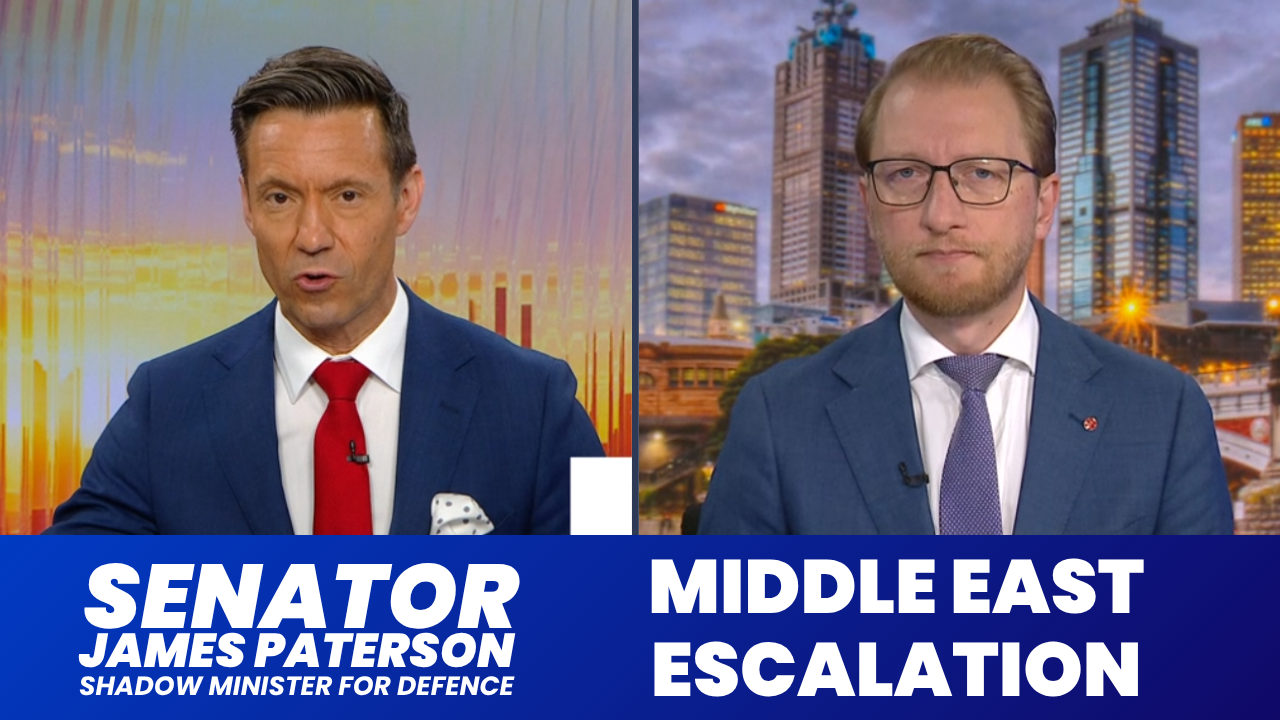
ALEX THOMAS: Let's speak to Shadow [Defence] Minister James Paterson, who joins us live now. James, we'll probably get to domestic politics in just a moment, but I want to start with our breaking news this morning. The US confirming with announcements through President Donald Trump and Secretary of War Pete Hegseth that it will strike Iran again in the coming hours. Are those threats going to bring us closer to peace?
SENATOR JAMES PATERSON: Good morning. I think it's remarkable that the ceasefire has held as long as it has for almost two months now, given the significant exchange of hostilities earlier in the year between the United States, Iran, and Israel. And it's clear to me, with Iran's decision to down a US helicopter and also to strike directly against Israel, that they are not interested in a peace deal at this point in time. They clearly want to increase pressure on the United States, economic and political pressure, in the hope that they'll get a better deal. Australia's interests are clear. We want an end to the hostilities, but not on any terms. We want an end to the hostilities on acceptable terms. Things like Iran being prevented from tolling the Strait of Hormuz, things like Iran being prevented from further enrichment of uranium towards a nuclear weapons program.
THOMAS: How are you feeling about AUKUS right now, with the US struggling to bring about peace in the Middle East, the UK having a huge row currently over its defence spending and the ongoing concerns here about the subs we're getting?
PATERSON: There's a big debate in the UK this week where the Defence Minister and Foreign Affairs Minister are for talks with their counterparts about their ability to deliver SSN AUKUS with Australia, which is the nuclear submarine program which will replace the Virginia-class submarines that we're seeking from the United States. It's due to deliver its first submarines in the 2040s. So I think, actually, it's a healthy thing to have scrutiny and debate and focus now on how best we deliver those submarines, because we do have a decade and a half to get that right, and it will require more investment, more effort and more involvement between our partners over the next couple of years to make sure we achieve that. But I'm very comfortable having a focus on that right now. I think that's what we need to make sure it is achieved.
THOMAS: Back home, One Nation, raising more than a million dollars in a single day. Its poll lead remains. Is it time for formal talks between Angus Taylor and Pauline Hanson?
PATERSON: No, it's not. Any discussions between the Liberal Party and any other political party about preferences will happen much closer to the election. Preferences cannot be finalised until we know the candidates a party is running in each seat because, on a seat-by-seat basis, we make a case-by-case judgement about whether or not we want to allocate preferences to a candidate. We know that many parties, One Nation included, in the past have had great difficulty in selecting candidates that are suitable people for public office. In the most recent South Australian election, they had a candidate who was wanted for serious crimes in the United Kingdom while being endorsed as a candidate. So no, I think those conversations are premature at this point of the cycle.
THOMAS: I mean, we've spoken before, haven't we, that part of the One Nation surge is just voters' desire for change, really. We're all a bit dissatisfied with cost of living, with how things are right now. There have been at least three different measures of consumer confidence this week alone, none of them trending upwards. How concerning is that for you?
PATERSON: It's very concerning. I mean, I think the sentiment in Australia right now is very bleak. I think Australians have no hope for the future after four very tough years under Labor, and they do desperately want change. And the Liberal Party's task is to convince Australians that we are the best vehicle to deliver that change for them, that any other party is not as well equipped as we are to have an economic plan to get Australia out of this mess. We've started that process in Angus Taylor's Budget Reply, where he set out our tax-back guarantee that would index income tax brackets to inflation to make sure that workers never again face a tax rise simply because inflation has pushed them into a higher tax bracket. That's the first start of our plan. We'll have a lot more to say between now and the election as we work to earn the trust of voters.
THOMAS: What's your assessment of the current economic indicators ahead of that RBA interest rate decision next week?
PATERSON: Look, I think they are very bleak. We have an environment of high and rising inflation. We have that environment of a softening labour market, increasing unemployment. If those kind of trends persisted over a period of time, then you would be back to the economic misery of the 70s, which we experienced stagflation of rising unemployment and rising inflation at the same time. And that is a direct result of a government that's pouring fuel on the inflation fire. They are driving up inflation by being unable to control their spending, by adding too much stimulus to the economy, and the RBA has been very restrained about that, but has become increasingly frustrated, clearly, that they are doing all the heavy lifting to lower inflation. What we need is a government that can get its budget under control so Australians' budgets can be under less pressure.
THOMAS: Okay, James Paterson, Shadow [Defence] Minister, thanks for your time.
ENDS