

Media
|
News
September 7, 2026
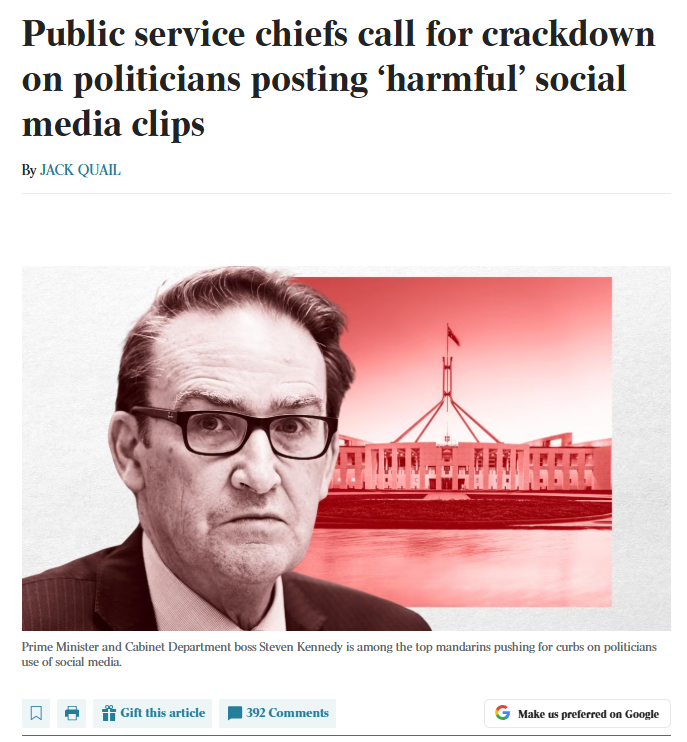
Canberra’s departmental chiefs have demanded politicians be restricted from posting “potentially harmful” video clips of bureaucrats’ parliamentary testimony on social media, but insist their request is not aimed at ducking public scrutiny.
The practice of public servants testifying before parliamentary committees has come under growing scrutiny after senior Defence official Celia Perkins appeared before a Senate probe last Friday, protesting what she claimed to be the selective posting of her colleagues’ comments.
Arguing the posts were undermining her ability to assure “physical and psychological health and safety” of her staff and had raised “significant security concerns”, Ms Perkins’ request was quickly dismissed by senators who argued they were within their rights to distribute testimony as they saw fit.
Ms Perkins’ request was subsequently clipped up and posted online, adding to the catalogue of viral parliamentary clips including Treasury admitting the petroleum resource rent tax yields less than beer excise and NEMA’s boss taking a question on notice about an unanswered question on notice.
Senior officials including Treasury secretary Jenny Wilkinson and Home Affairs boss Stephanie Foster have shot to prominence on social media following testy estimates hearings, with Coalition, Greens and crossbench MPs sharing clips of their sometimes aggressive questioning of public servants.
But in a submission authored by the Secretaries Board – a committee of departmental heads chaired by Department of the Prime Minister and Cabinet boss Steven Kennedy – the nation’s top bureaucrats said they had become increasingly concerned about posting of officials’ testimony online.
Selective video snippets, the departmental heads claimed, presented the public with an “incomplete or misleading” representation of testimony that unfairly pinned government policy on federal bureaucrats, exposing them and their families to online “ridicule, hostility or abuse”.
Comment sections on the clipped posts frequently could descend into “highly offensive and sometimes defamatory” vitriol, with bureaucrats targeted over their appearance, likened to Nazis and paedophiles, and also branded with a slew of abusive rhetoric.
“We are aware of situations where agencies have been required to conduct insider threat assessments in response to these circumstances,” the submission provided to a Labor chaired committee examining parliamentary standards said.
To curb the harm posed by video clips, the Secretaries Board called on parliament to develop new rules governing the “appropriate use” of committee broadcasts, which focused on “promoting fair representation of evidence, provision of appropriate context and discouraging misleading editing or presentation.”
Options canvassed by the board include mandating that politicians include links to complete transcripts or full hearing recordings with any video snippets, and forcing comment sections be deactivated to protect officials from online vitriol.
“This would minimise the possibility of defamatory and/or harmful statements being made about Official Witnesses,” the submission said.
In the event that the parliament did not implement restrictions preventing the “potentially harmful” use of committee evidence on social media, the board recommended new guidelines be issued to politicians instead.
These would include encouraging politicians to present excerpts in full, and in a manner that “accurately reflects the substance of proceedings”. They would also be pushed to avoid “misleading editing practices” such as biased captions, refrain from commentary that targets individual officials, and be called on to “consider appropriate contextual material where excerpts are published.”
Alongside mooted social media restrictions, the Secretaries Board requested the committee consider education for parliamentarians participating in committees on the role of public service, and “explicit guidance” on the treatment of witnesses to stop questioning resulting in “personal attacks”.
“This submission is not about limiting scrutiny. lt is about ensuring that scrutiny remains focused on evidence, administration and accountability rather than becoming personal,” the board’s submission said.
Addressing Ms Perkins’ request during a speech on Monday evening, Labor senator Raff Ciccone agreed that bureaucrats should not dictate which testimony appeared on social media, but argued the proliferation of decontextualised clips was a cause for concern.
“Perhaps this parliament should look at how evidence given to committees is used, and whether MPs need our own standard for how we describe witness evidence online,” he said.
Others, however, were far more sceptical of limits on how officials’ testimony was presented.
Greens defence spokesman David Shoebridge claimed the secretaries’ intervention amounted to a co-ordinated effort to “defang parliament”, and urged the public to push back against the proposal.
“The idea that clips should have no captions and that comments should be turned off is plainly offensive. Comments allow for public engagement and captions are essential to understand what happened,” he said.
“This is how democracy dies, with a thousand cuts from people with power and privilege who work together to silence dissent.
Concerns were also raised by opposition defence spokesman James Paterson who labelled the proposal an “extraordinary overreach” in a parliamentary democracy.
“While we have a responsibility to treat all witnesses with respect, Australians are forming their own judgment about the failure of some officials to answer questions,” he said.
“Too often, extraordinary obfuscation is engaged in to avoid directly answering reasonable questions, and the parliament’s responsibility to hold executive government to account is frustrated.”