

Media
|
News
May 20, 2026
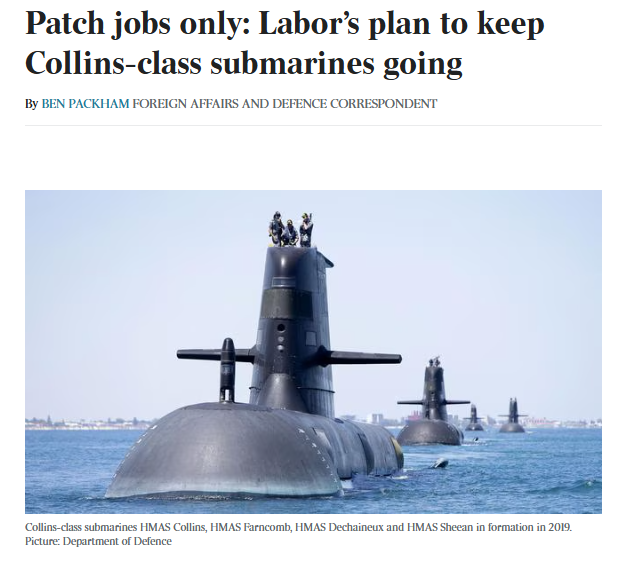
Upgrades to the navy’s Collins-class submarines will be drastically scaled back, casting doubt over the boats’ ongoing reliability, as the government tries to squeeze another decade of life out of the ageing vessels.
Defence Minister Richard Marles revealed on Tuesday the government had thrown out its longstanding “life-of-type extension” plan to replace all of the submarines’ critical systems, and will now do so only on an as-needs basis. At the same time, the forecast cost of the upgrades, due to begin at the end of this month, has more than doubled to $11bn over a decade.
The change of tack confirms reporting by The Australian more than a year ago that the subs were headed for “LOTE-lite” refits.
The government claims the refits will still get another 10 years’ life out of the boats, avoiding a capability gap before the arrival of the navy’s nuclear-powered submarines, and safety will be paramount in ongoing operations.
Mr Marles said under the new “conditions-based sustainment” model, new weapons and combat systems would be installed in the submarines, while prioritising the refurbishment of other key components including their diesel engines, generators and main motors.
He said the plan would reduce project risk while maximising submarine availability.
“This approach will ensure our Collins-class submarines remain a potent and highly capable undersea platform today and for years to come,” Mr Marles told the Lowy Institute in Melbourne.
Experienced submariners said the plan would increase the risk of breakdowns at sea, as key systems were pushed beyond their intended 28-year lifespans. “Reliability clearly has to diminish, simply because of age,” retired Commander Tony Vine told The Australian.
“Components have a finite life. Engines can have certain components replaced, yes, but things often get to a point where they’re not sustainable to refurbish.”
Another retired Collins-class submariner, speaking on condition of anonymity, said there was “no doubt they will be less reliable, and just at the time when we need the capability”.
“These things were only designed to run for a certain lifespan,” the former naval officer said. “They are already seeing problems that they would never see before because the boats were designed to a 28-year design life.”
The most heavily used of the boats, HMAS Farncomb, will enter its LOTE upgrade at the end of the month, but its overhaul is expected to take longer than the originally planned two years.
Mr Marles said it would receive “a detailed engineering assessment period to tailor its life-of-type extension upgrades and inform work required across the class”.
The upgrades will be undertaken concurrently with other maintenance schedules, which will leave multiple submarines out of the water at the same time. However, the navy hopes to have at least two submarines available for tasking at any one time. The government’s “optimal pathway” to acquire nuclear-powered submarines requires the Collins boats to continue operating until the mid-2040s, to ensure the nation has an ongoing undersea warfare capability while the navy builds its fleet of AUKUS nuclear subs.
The Collins boats have suffered from poor availability in recent years, with The Australian revealing in November 2024 that only one of the six boats was operational. Senate estimates heard evidence of corrosion problems in a number of the submarines, while supply-chain issues during the Covid pandemic and longrunning industrial action also took a toll on maintenance schedules. Defence Industry Minister Pat Conroy said the new LOTE plan flowed from an assessment of the Collins program delivered to the government more than two years ago by retired senior US naval official Gloria Valdez, who argued the approach was “a lower-risk option that provides better value for money”.
“This is the lowest-risk way of getting that extra 10 years of life for each submarine, doing it by a submarine by boat assessment, and I want to emphasise that safety is paramount,” he said.
“Every decision will be driven by the engineering advice on how to ensure that the submarines are safe and able to be operating for those 10 years.”
Mr Marles sought to blame the Coalition for the state of the Collins boats, arguing it was responsible for “years of indecision” on their replacements. He claimed Labor, not the Coalition, was “the natural party of defence”.
Opposition defence spokesman James Paterson said the minister had “used the cover of a remarkably partisan and defensive speech to admit a major descoping of the Collins-class life-of-type extension”.
“As is often the case, he’s failed to provide the details transparently to the public,” Senator Paterson said. “Which aspects of upgrades previously planned are now being abandoned? And how much is the Albanese government cutting from the program?
“If Richard Marles put as much energy into persuading his expenditure review committee colleagues as he does attacking the previous government, maybe the ADF wouldn’t have to absorb as many cuts to capability as it has on his watch.”